Potash Mining
Incompatible with Pure Michigan
Water is Under Attack in Michigan
The state permitted a Colorado company to extract and destroy over 1,200 gallons per minute of Michigan’s groundwater for a new potash mine. Nestlé/Blue Triton’s impact on the environment from water extraction would pale compared to this proposed mine. This project will be a disaster for residents, businesses, and the mid-Michigan ecosystem.
Michigan Potash & Salt Co. LLC (MPSC) is attempting to establish a large potash solution-mine in mid-Michigan.
The company, based in Colorado, has obtained permits for 11 high-capacity injection wells, sufficient to support a small initial phase of the project. The company has also received a permit for the round-the-clock withdrawal of 1200 gallons per minute of fresh water (although we believe that number to be grossly understated). This level of water-taking would dwarf that of Nestlé/Blue Triton, approximately five miles away.
All of that fresh water is to be poisoned and discarded through deep waste-injection wells, thereby removing it from the water cycle for all time.
Incredible though it may seem, this initial phase of operations is only about one-eighth the scale of what the company claims it will have up and running within 3 1/2 years.
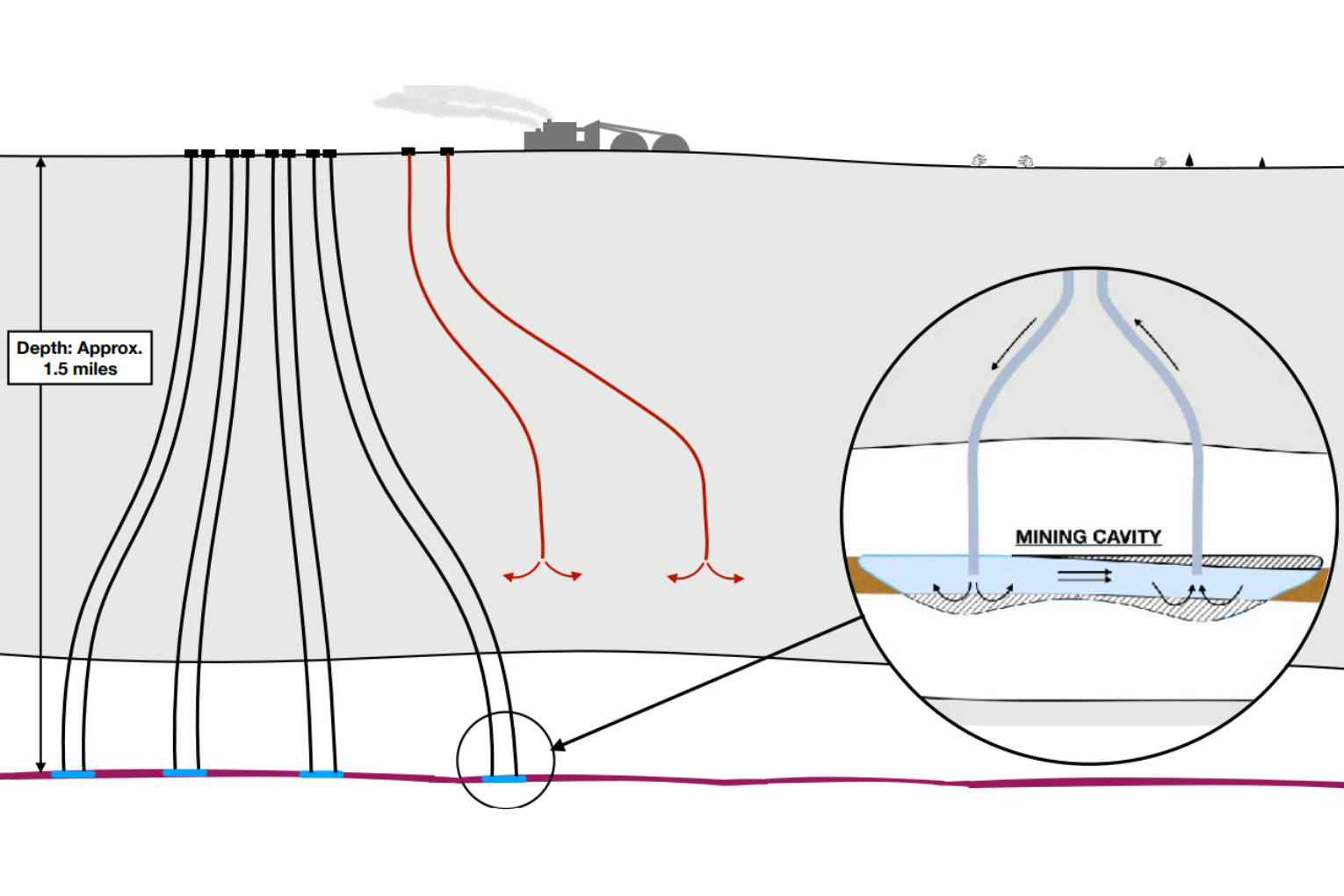
MPSC presently holds permits to undertake a small-scale potash solution-mining operation incorporating 8 bore-holes servicing 4 cavities, along with 2 waste-injection wells, as depicted below. (The company also holds a permit for one additional waste-well.) It is unlikely that an operation of this size could produce more than 130,000 tons of potash per year.
Background
While this solution-mine would, at the outset, be withdrawing many times as much water as Blue Triton, even that volume will pale next to what will be taken if & when the company ever achieves “full buildout” of its project at one million tons of potash per year.
These pumping rates carry a very high potential of:
- Drawing down the water table and drying up local wells
- Salt and other minerals intruding into the aquifer from below
- Drying up local streams, lakes, and wetlands
- Reducing groundwater flows to the Muskegon River
Efforts by Michigan Citizens for Water Conservation have been the only challenges to the granting of permits to-date. The Trump administration’s EPA brushed aside concerns about aquifer depletion, leaky pipelines, and groundwater contamination and quickly granted permits for 3 deep waste-wells [while, in the process, insisting that bald eagles and Trumpeter Swans do not exist in Osceola County].
In the seeking of State permits, the Denver-based company made full use of the secrecy provisions of Michigan’s Mineral Wells Act. Those provisions allow them to hide information related to mining wells from public scrutiny. This legislated secrecy displays the power of Michigan’s mining industry. However, because the 3 waste-wells are not covered by those secrecy provisions, MCWC has been able to obtain a good deal of information about the company’s plans.
The company has engaged in a years-long public-relations campaign while hunting for well over a billion dollars to finance its project. Previous (and much larger) companies, even though they possessed considerable mining experience and plenty of money, gave up on potash-mining on a much larger and safer site nearby.
The company often points out that the U.S. reliance on imported potash leaves the country at the mercy of Russia & Belarus, and now the invasion of Ukraine has caused a sharp spike in prices. However, they neglect to mention that the U.S. gets 83% of its potash imports from Canada, the world’s largest producer, which is currently ramping up its production capacity. Those huge mines sit just across the border from America’s agricultural heartland and enjoy direct rail-access to it. [MPSC will lack rail-access of any kind.] Prior to the Ukraine invasion, there was a long-standing worldwide glut of potash which kept prices depressed. Long-term, we can’t see how Ukraine’s suffering will enhance MPSC’s prospects.
Cross Section of the Proposed Potash Mine