 Potash Mining
 Potash Mining
Potash Water Withdrawal
Michigan Potash’s proposed mining operation would require massive fresh water withdrawals from local aquifers, potentially consuming seven times more water than previous mining operations due to its dramatically larger scale. This could cause serious environmental impacts including water table drawdown, well contamination, and depletion of local springs and wetlands.
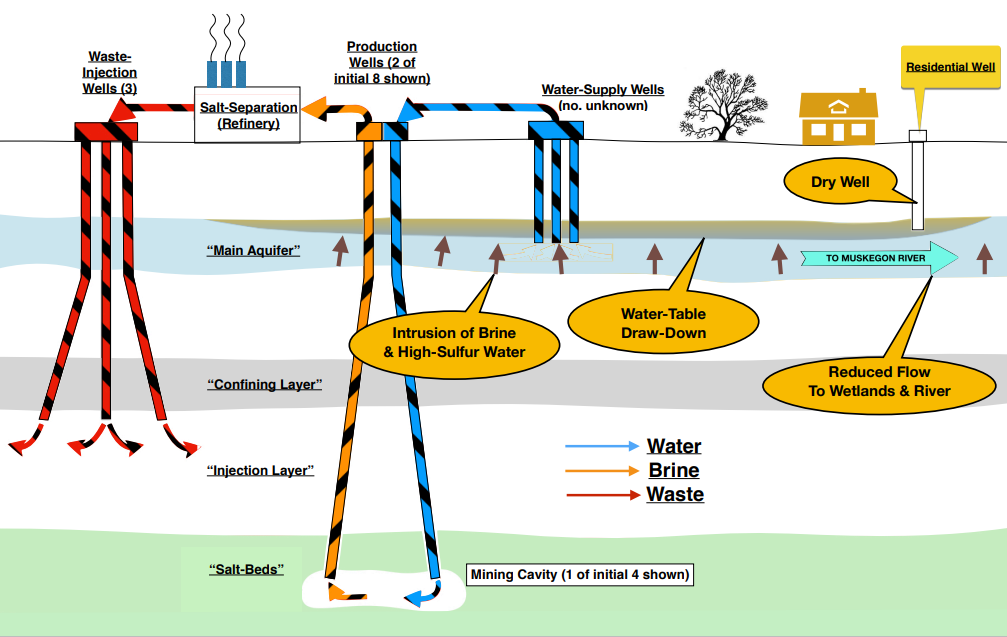
Problems Associated with Large-Scale Water Withdrawals are Well Known
- Drawdown of the water table, results in reduced groundwater flows
- Drying up of wells, springs, & wetlands. Intrusion of brines & other minerals from below
- Deterioration of water quality in area wells as ancient “fossil-water” containing high levels of sulfur & minerals is drawn upwards
Residents around the Nestle & Cargill sites are already experiencing some of these problems, and at pumping rates drastically lower than those planned by Michigan Potash. (Also, the Nestle pumping rates are intermittent, whereas MPSC will pump continuously.)
Area residents are accustomed to drinking some of the best water on the planet, which is what attracted Nestle in the first place.

Michigan Potash & Salt Company has been inconsistent (and we believe, disingenuous) in providing water consumption rates
Both the company and DEQ/EGLE claim that a previous area potash mine operated for many years without causing damage to the aquifer or neighboring wells. This is not only untrue (there have been problems, both from contamination and drawdown), but consider the difference in scale of operations: MPSC plans to mine over a million tons of potash per year. The previous mine, in its very best year, produced only 150,000 tons. This means that MPSC would consume almost seven times more water!
The company is once again trumpeting plans to “break ground” soon, yet it has never conducted a sustained pumping test to determine the local aquifer’s ability to supply its needs. [It’s possible that the company doesn’t even know what those needs will be.] Local residents rely on their own private wells for 100% of their water, and their lives would be unsustainable without this aquifer.
There’s also the issue that the company appears to be grossly understating the amount of salt it will produce. Salt is considered a waste product when mining potash. While MPSC often predicts that they will produce approximately 13% more salt than potash, the area’s previous mining operation produced 4 times as much salt as potash. If this company ever reaches its annual goal of a million tons of potash, it could be faced with getting rid of up to 4 million tons of salt per year. This is more salt than the entire state of Michigan currently produces and far in excess of what current markets could absorb. If the company has to re-dissolve that salt for disposal through waste wells, it will multiply their fresh-water consumption many times (reclaiming water through distillation will not be an option).