Newsletter
Make Clean, Affordable Water Accessible to All in Michigan!

Water Affordability

Authored by

Newsletter: Winter 2023-2024
At the beginning of this year, Senator Chang organized a workgroup of elected officials, water providers, activists from Peoples Water Board, National Resources Defense and others, to meet weekly for seven months to sketch out what a water affordability plan for low-income residents should look like.
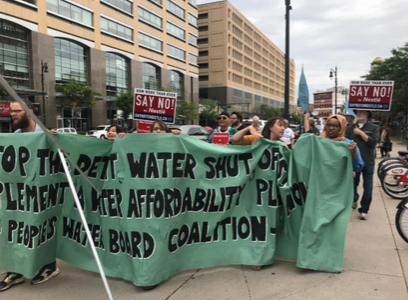
 On October 2nd, Senator Stephanie Chang held a press conference and announced that a package of Water Affordability bills was ready to be introduced into the Michigan House and Senate. After almost two decades of fighting against water shutoffs and advocating for clean, accessible, affordable water and after several months of weekly meetings with activists, elected officials, water providers and other stakeholders, the legislation has finally been created to meet the needs of Michigan residents.
Public hearings were held in committees in both the House and Senate before legislators left for their home districts for the year. The next step, when legislators return, will be for the committees to vote on the bills, followed by a floor vote in the senate and house. Given the loss of two Democratic representatives, the legislation may not move again until May.
Briefly, these are the bills. Links to the full bills are at bottom.
- A Water Affordability Program will be created which caps the water and sewerage bill at 3% of a low-income household’s earnings. It also reduces or forgives up to $1500 in unpaid back bills, and provides up to $2,500 for plumbing repairs. And there are protections to keep back bills from being added to property taxes, which could help to prevent home foreclosures.
- A bill to create a Water Affordability Fund from $2 per monthly meter to finance the program. According to Sen. Chang: “This fund is modeled after the Michigan Energy Assistance Program for which every electric utility customer pays a small monthly fee to ensure that low-income households can get help with their energy bills. The MEAP program was created by bipartisan legislation during the Snyder administration.”
- A bill that provides protections against water shutoffs including requiring the provider to notify the household of the overdue bill, providing them with information on the Affordability Program and encouraging them to apply. No shutoff will occur during the application process or afterwards if one
meets the terms of agreement. - Decriminalization of Water reconnections. Reconnecting a water line to a home, after being shut off for inability to pay would no longer be a five year felony. It would be a civil infraction with community service.
- A bill to protect renters from exorbitant fees passed on from landlords and from shutoffs if the landlord fails to pay the water bill.
Our job now is to whip up votes. Talk with your elected officials in both houses, on both sides of the aisle, about the bills and encourage their support. Call them monthly to draw their attention to this important legislation that will not only help low income residents pay their bills, but will help utilities make repairs and keep down the costs and increases for all Michiganders.
Many elected officials, activists and even water providers support this much needed legislation. But there are exceptions, such as Macomb County’s Public Works Commissioner Candice Miller who claims that Macomb County Residents don’t need the Water Affordability Program because they have WRAP (Water Residential Assistance Program).
Unfortunately WRAP IB (Income Based) is not financially sustainable. While federal funds have been used to prop up this program since the pandemic, those funds are running out. A state fund must be set up to make the bills affordable and to support those who find themselves in a medical or other crisis.
Senator Chang’s view: “The need is very clear. In my own district, in the city of Warren… there were over 2,800 Warren residents who were behind on their water bills. In Roseville, there were over 700 households that were behind on their water bills. There are a significant number of Macomb County households who are behind on their bills and are below 200% of the federal poverty level.”
Poverty in the suburbs is climbing. The suburbs around Detroit experienced an 87% increase in poverty between 2000 and 2014. Since 1980, the cost of water has risen by 188% and in some urban areas by 320%. The rise in poverty, along with the growing costs of water, has made water and sewerage bills unaffordable for many suburban households.
Many suburbs rely on shutting off water to households and imposing liens on the property taxes of these residents to force them to pay. These are not solutions. It’s time we passed Water Affordability legislation to prevent families from having to live through the devastation of being without water, the fear of having their children removed by Protective Services or having their homes foreclosed.
Share!
Call on your elected representatives and senators to pass this much needed legislation!
It’s time we enacted basic public health legislation in Michigan to help low income households obtain their human right to clean water. Contact Diane Weckerle (djweck@gmail.com) if you would like to participate in a training with People’s Water Board.
The following links will take you to the Michigan Legislature’s website where you can view copies of and progress of the bills. (House bills are HB 5088-5093)
SB 0549 – Water Affordability Program
SB 0550 – Water Affordability Fund
SB 0551 – Water Shutoff Protection Act
SB 0552 – Decriminalization of Illegal Water Turn On
SB 0554 – Landlord Tenant Water Bill Rights