Newsletter
Water Consumption & Destruction

Mining
Potash Mining
Water Grabs


Authored by

Newsletter: Winter 2022-2023
Since coming to our state in 2011, Michigan Potash Company (MPSC) has avoided disclosing how much fresh water they will consume. The company initially “registered” with the DEQ (now EGLE) to withdraw from the Big Stone Creek watershed 1,200 gallons-per-minute which, although obscenely large, was conveniently low enough to avoid triggering a review by DEQ officials. Even though the company’s announced potash output has since nearly doubled, that number remains unchanged. Permits for dramatic increases can easily be obtained by drilling additional wells in neighboring watersheds.
The company has avoided disclosing its actual anticipated water-consumption and most other information about their venture, in part, by steadfastly resisting efforts by the Osceola County Planning Commission to understand, and plan for what would become the largest development, by far, in county history. Since Osceola County is not zoned, that commission cannot compel the company to comply with its repeated requests. Meanwhile, MPSC hides behind provisions of Michigan’s infamous Mineral Wells Act that prevents EGLE from disclosing any information about a solution-mining operation without the consent of the company involved (a manifestation of raw political power exerted by the state’s mining industry).
The issue of fresh water destruction is very real. Over the course of this project’s planned lifetime, more than one hundred square miles would be riddled with over a thousand injection-wells. Each of those wells will have been connected to a centralized refinery by a network of access roads and pipelines transporting hot, concentrated brine solutions at pressures of 2,000 psi. Pipelines such as these are the reason that leaks and spills are a common feature of solution-mining.
“The process itself is intensive in terms of water usage, and the contamination of nearby water sources like aquifers is a real risk if solutions leak.”
Source: Agriculture Investing News, 8/21/18
In spite of the fact that, once spilled, those brines migrate rapidly and are toxic to all area lifeforms, Michigan Potash has chosen to operate in a hilly and particularly vulnerable area where lakes and streams abound, and wetlands, springs, seeps, and shallow, unprotected aquifers are common hydrogeological features. This is not the sort of terrain where solution-mines are normally located.
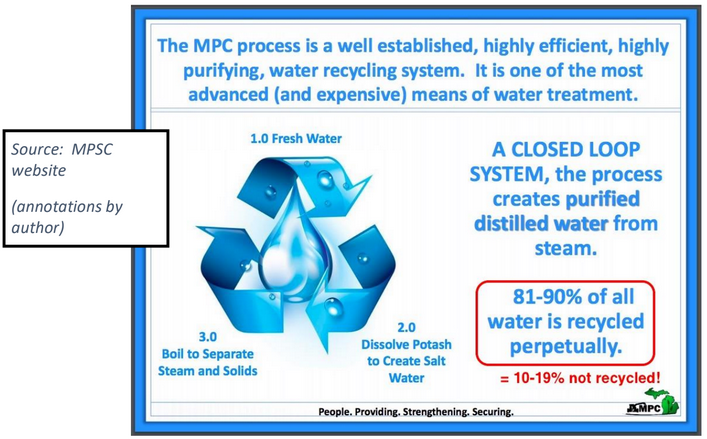
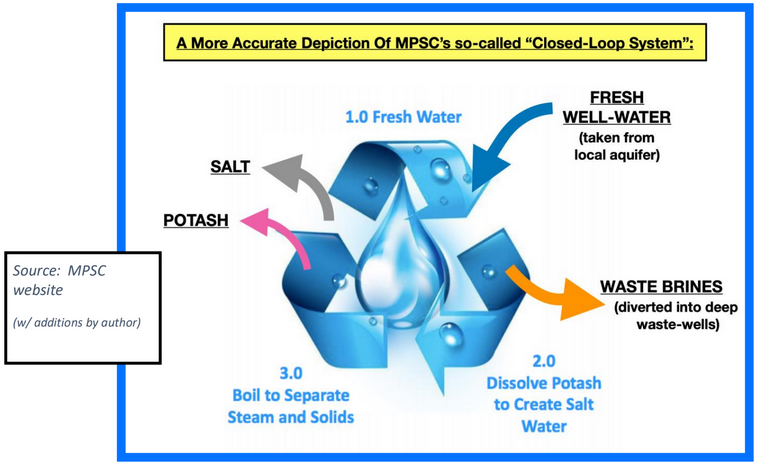
A more immediate threat will be posed by the project’s voracious appetite for fresh water: Fresh water is needed to dissolve the minerals being mined: potash (sylvite) and salt (halite). The company’s unwillingness to disclose how much water they will take, or to provide a consistent answer as to the amount of salt (halite) they will produce, is revealing.
The company has chosen instead to deflect concerns about water consumption or contamination through a disingenuous public relations campaign: At the heart of this campaign is the oft-repeated assertion that they will operate a “closed-loop system” where the water boiled off to produce potash and salt will be condensed and reused.
The company boasts that “81-90% of all water is recycled perpetually.” But this also means that they will continuously be disposing of 10-19% of their process-water. When you consider that the company’s process will involve constantly flushing water through more than 30 subterranean cavities, each growing to the size of eight football fields, you begin to grasp the total amount of water involved in solution-mining potash. The fact that 10-19% of that total would continually be polluted, discarded as waste, and replaced with fresh well-water is unconscionable.
The ultimate obscenity is that, by injecting this so-called “waste-water” deep into the Earth, it will effectively leave the water-cycle for all time.
Government (ie: Corporate Welfare) To The Rescue
Prior to COVID, this venture did not appear to be going anywhere. Despite years of effort, MPSC has not attracted the money it needs for this venture. It’s understandable that potential investors would be leery of resurrecting an endeavor that didn’t pay off in the past. (Over the course of 25 years, three large and experienced mining companies had worked this ore-body, and each, in turn, gave up.) Would-be investors likely know the reasons why past efforts fizzled out, including the thinness of the ore-body, excess salt production, distance from major markets, and lack of rail-access. They’d also be aware that Michigan Potash will face handicaps that those large companies did not, including: Lack of experience, Limited access to capital, Heavy debt-load, and Problematic site location.
This is a project dedicated to the wholesale destruction and disposal of fresh water.
COVID, and the Ukraine war appear to have drastically changed this company’s prospects, allowing it to pivot away from the rational functioning of capital markets and into the wide-open arms of state and federal governments newly awash in taxpayer largess.
- In March of 2022, legislators in Lansing approved a 50-million-dollar grant for the project.
- Not to be outdone, the U.S. Department of Agriculture upped the ante when, on 3/11/22, it announced a 250-million-dollar program of grants “…to support independent, innovative, and sustainable American fertilizer production to supply American farmers.” In that announcement, U.S. Agriculture Secretary Tom Vilsack portrayed the Michigan Potash project as a shining example of what they’re looking to support. Subsequently, the USDA announced huge increases to this grant program. It’s expected that grant recipients will be announced soon.
- Not to be outdone in turn, on 9/27/22, Michigan’s Economic Development Corporation (MEDC) announced its intention to issue $225,000,000 in tax-exempt bonds on behalf of Michigan Potash & Salt Company. The rationale is that tax-exempt status (and association with state government) will make the project more palatable for investors. Given this venture’s inherent risk (which must be compensated for by higher returns), MEDC will essentially be issuing “tax-exempt junk-bonds”.
In the wording of its “Inducement Resolution” MEDC revealed something interesting:
“WHEREAS, the Project will include facilities for the collection, storage, conveyance, and disposal of industrial wastewater (sewage) and solid waste realized as part of the solution mining and product manufacturing processes;”
Herein lies the ultimate irony of MEDC’s move: They are employing a tool meant to assist businesses devoted to coping with Michigan’s serious waste-disposal problems, but they’re using it instead to create a business that will pollute and dispose of massive quantities of fresh, potable well-water. (That this is being done in pursuit of a commodity which Canada will continue supplying in abundance and at a lower price makes it all the more absurd.)
Lack of Due-Diligence
While both state and federal governments are locked in what could best be described as a “reverse feeding-frenzy”, it appears that little or no due-diligence has been taking place. How else to account for funneling so much money to a company with no employees, no track record, no mining experience, no rail-access, negligible assets, and a business plan to re-run previously failed mining efforts?
In Summary
By giving away hundreds of millions of taxpayer dollars, our state and federal governments are attempting to foster what may be the biggest water-grab in Michigan’s history. At the same time they will be risking the widespread contamination of surface and sub-surface water resources from brine pipelines encompassing more than a hundred square miles of highly vulnerable terrain. —All of this to create 129 jobs—
IF THERE WAS EVER A TIME TO DECLARE AN END TO MICHIGAN ’S OPEN-SEASON ON WATER, THIS IS IT.
Put water at the top of the state agenda!